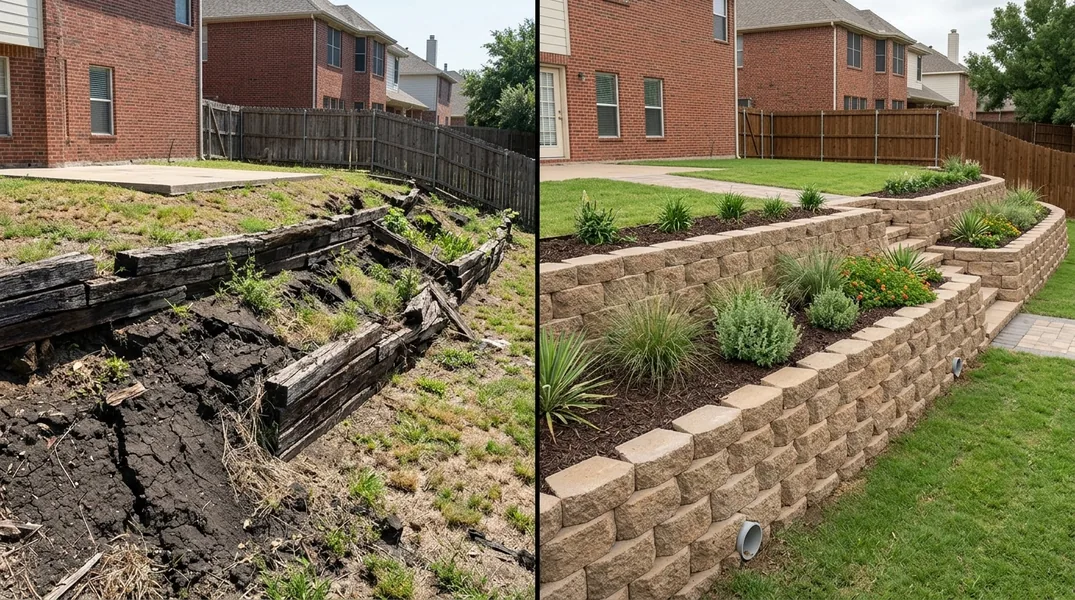
Why Plano's Black Clay Soil Destroys Retaining Walls
If you live in Plano, you already know the ground beneath your feet is not ordinary dirt. The region sits on expansive black clay, a soil type that swells dramatically when wet and shrinks just as aggressively when dry. This constant cycle of expansion and contraction exerts immense pressure on anything buried in or resting on the soil, and retaining walls are especially vulnerable. Unlike a house foundation that distributes weight across a wide footprint, a retaining wall is designed to hold back earth, which means it absorbs the full force of that moving clay.
During a wet spring, the clay can expand by several inches, pushing against the back of the wall with thousands of pounds of lateral force. When summer arrives and the soil dries out, the clay contracts and pulls away, leaving voids that undermine the wall's base. Over time, this relentless push and pull causes even well-built walls to lean, crack, and eventually fail. Homeowners in Frisco and Allen face the same conditions, which is why proper engineering for our local soil is non-negotiable.
The Warning Signs of a Failing Retaining Wall
A failing retaining wall rarely collapses without warning. The soil gives you clues first, and learning to read them can save you from a much larger repair bill. The most obvious sign is a leaning retaining wall. If the top of the wall is no longer level or has started to tip away from the soil it holds, the pressure behind it has already exceeded what the wall was designed to handle. Even a slight lean is a red flag that should be inspected promptly.
Another common symptom is a bowing retaining wall, where the middle of the wall bulges outward in a curve. This often indicates that water is trapped behind the wall and the drainage system has failed. You may also notice horizontal or stair-step cracks in concrete or block walls, soil washing out from around the base, or gaps opening between the wall and the earth behind it. A bowing retaining wall fix is almost always easier and less expensive when addressed early, before the structural integrity is compromised. If you spot any of these signs, it is time to call a professional for an assessment.
How Poor Drainage Accelerates Wall Failure
Water is the enemy of any retaining wall, and in Plano's black clay, it has nowhere to go. Clay drains very slowly, so when rain falls, water accumulates behind the wall instead of percolating through the soil. Without a proper drainage system, that water saturates the backfill, adding enormous weight and hydrostatic pressure. Many older walls were built without gravel backfill, perforated drain pipes, or weep holes, which means they were doomed from the start in our climate.
If your wall shows signs of water damage, such as efflorescence (a white, chalky residue), soggy soil at the base, or water pooling behind the wall after storms, the drainage is likely inadequate. A professional assessment can determine whether the wall can be retrofitted with proper drainage or if a more extensive Retaining Wall Repair is needed. In some cases, Retaining Wall Replacement with a properly engineered drainage plan is the only lasting solution.
Retaining Wall Repair Near Me: When to Call a Pro in Plano
If you have noticed a leaning, bowing, or cracking wall on your property, you may be searching for retaining wall repair near me and wondering whether it is a DIY project. The honest answer is that retaining walls are structural systems, and mistakes can lead to property damage or injury. A wall that is already failing under the pressure of expansive clay requires a professional evaluation to determine the root cause, whether it is drainage, inadequate footing, or simply age and poor construction.
At Plano Retaining Wall, we specialize in diagnosing and fixing walls built on our challenging soil. Whether you need a targeted repair or a full replacement, we can recommend the best path forward. We also offer Concrete Retaining Walls designed specifically to withstand the movement of black clay. If you are unsure about the condition of your wall, do not wait for it to fail completely. Call us at (469) 661-3741 or request a free estimate to get an expert opinion.
Building It Right: Retaining Wall Installation That Lasts
The best way to avoid the headaches of a failing wall is to build it correctly from the start. Proper Retaining Wall Installation in Plano begins with a deep understanding of the soil. That means excavating below the clay layer, installing a compacted gravel base, and using a drainage system that directs water away from the wall. It also means selecting materials that can handle the load and movement, such as steel-reinforced concrete or engineered block systems.
Many failing walls we see were built by previous homeowners or contractors who underestimated the power of black clay. They skipped the gravel, used inadequate footings, or failed to account for water pressure. If you are planning a new wall, or if you are replacing an old one, invest in a contractor who understands local soil conditions. A well-built wall should last decades, even in Plano's challenging environment. To learn more about our process and pricing, reach out to our team today.
Looking for a professional retaining wall contractor in Plano? Plano Retaining Wall responds fast for all your retaining wall needs.
Get a Free QuoteOur services: Retaining Wall Installation · Retaining Wall Repair · Retaining Wall Replacement