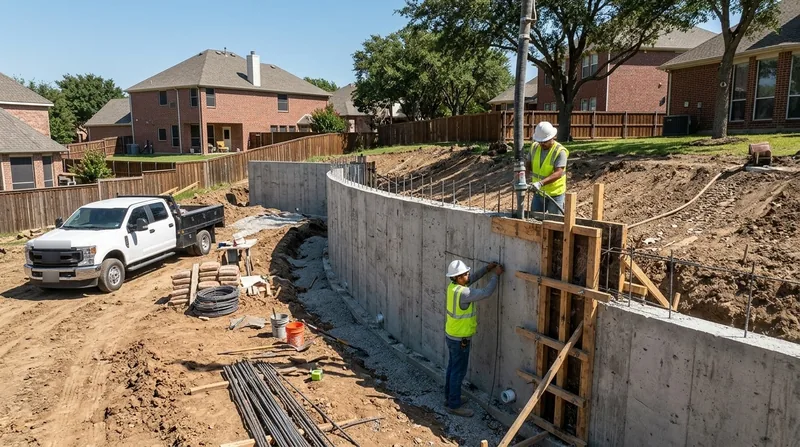




Concrete Retaining Walls in Plano are the go-to solution when a grade change has to hold for decades, not seasons. Plano sits on deep black expansive clay that shrinks and cracks through August drought, then swells hard under spring thunderstorms and flash runoff. That soil movement is what pushes timber, stacked stone, and under-built block walls out of line across Hunters Glen, Gleneagles, and the older brick ranches near Downtown Plano. Poured concrete and reinforced CMU walls with engineered footings, rebar, and weep holes resist that cycle far better than any dry-stacked option. If you are holding back a pool deck, a driveway, or a tight lot-line grade change, concrete is usually the last wall you will ever pay for. For lighter grade changes, our retaining wall installation page covers the full range of wall types we build.
Why Concrete Retaining Walls Matter on Plano's Blackland Clay
Plano spreads across flat to gently rolling Blackland Prairie, cut by the wooded greenbelts of Spring Creek, Rowlett Creek, and Russell Creek, with steeper draws around Arbor Hills and Oak Point Park. Homes run from 1970s brick ranches in east Plano to newer stone-and-brick builds near Legacy. In every one of those yards, the wall has to survive the same soil. Expansive clay moves a wall footer up and down, and a wall that was never engineered for that movement leans, cracks, or bulges within a few wet seasons.
- Concrete and reinforced CMU walls handle tall grade changes and surcharge loads from driveways and pool decks.
- Engineered footings set below the active clay zone keep the wall from heaving with each wet and dry cycle.
- Weep holes and gravel backfill release the hydrostatic pressure that builds during North Texas flash runoff.
- Poured concrete gives a clean architectural face for pool surrounds and tight lot lines where block would look bulky.
When a wall has to hold real weight and stay put, concrete is the material that matches Plano's soil and sun.
Key info: A creek-lot backyard off Spring Creek can take on a foot of runoff in a single spring storm. Walls built there without proper drainage and a reinforced footing are the ones we get called to rebuild in Plano and Murphy.
Before any wall goes in, check what the local building department requires. Many jurisdictions require a permit for walls above roughly 4 feet measured from the footing, or when the wall supports a surcharge such as a driveway or structure. You can start with the City of Plano for local permit guidance, and we confirm the current thresholds with the building department before we pour.
How We Build a Concrete Retaining Wall in Plano
We do not guess at footing depth on expansive clay. Every concrete wall starts with a site walk, a grade check, and a plan for where the water goes. Then we build in a fixed sequence so the wall is engineered for the load it actually carries.
- We walk the site and measure the grade change, the surcharge loads, and the access for equipment.
- We confirm permit requirements with the local building department and arrange engineered drawings when the wall is tall or tiered.
- We excavate to the engineered footing depth and set rebar cages rated for the wall height and soil load.
- We pour the footing and wall, or lay reinforced CMU block with grout and steel, depending on the finish you want.
- We install weep holes, gravel backfill, and drainage tile so water never sits behind the wall.
- We backfill in compacted lifts and finish the face, cap, and any adjoining hardscape.
That sequence is why a concrete wall holds its line through the August dry spell and the spring soak that follows.
Key info: On a pool deck job in Willow Bend, the wall had to carry the deck surcharge and stay tight to the lot line. We poured a reinforced footing with a drainage plane behind it, and the deck has not moved through five full clay cycles.
If your wall ties into a slope above a creek or a steep draw, we pair the concrete work with proper drainage. See our retaining wall drainage service for how we move water away from the wall.
Concrete Wall Approaches We Use in Plano
Not every grade change needs the same build. We match the approach to the load, the finish you want, and how tight the lot line is. Here is how the main options compare for Plano yards.
| Approach | Description | Best for |
|---|---|---|
| Poured concrete wall | Monolithic pour with rebar and an engineered footing, finished smooth or textured. | Tall walls, pool surrounds, and clean architectural faces. |
| Reinforced CMU block | Concrete block laid with grout and steel, faced in stucco, stone, or brick veneer. | Driveway and lot-line grade changes that need a finished look. |
| Cantilever wall | Reinforced concrete stem on a wide footing that resists overturning. | Tall walls holding back a surcharge such as a driveway or structure. |
| Tiered concrete wall | Two or more stepped walls with drainage between each tier. | Steep draws near Arbor Hills and Oak Point Park. |
We size every one of these to the actual soil load and grade change on your lot, not a one-size template.
Concrete Retaining Walls Cost in Plano: What to Expect
Concrete retaining walls start around From $35/sq ft in the Plano market, and that figure is a starting point, not a flat rate. The number moves with wall height, footing depth, the amount of rebar and steel the load requires, and how hard it is to get equipment to the back of the lot. A wall at a pool deck in Willow Bend costs more per square foot than a low garden wall in an east Plano ranch yard, because the surcharge load and access are different jobs.
Engineered drawings, permit fees, and drainage work also factor in. On a tight lot line or a steep draw near Arbor Hills, the excavation and backfill can add real cost. That is why we price from the site, not the phone. Get two or three estimates and compare what each one includes: footing depth, rebar spec, drainage, and permit handling. A cheap quote that skips the footing engineering is the one that leans in five years.
For a fuller breakdown of how we price concrete and other wall types, see our pricing page.
Concrete Retaining Wall Contractors Near Me in Plano: What to Check
Hiring the right contractor matters more on concrete than on any other wall type, because the footing and steel are buried and you will not see a mistake until the wall moves. Here is what to check before you sign, whether you are in Plano, Frisco, or McKinney.
- Confirm the contractor is fully insured, and ask for a certificate of insurance before work starts.
- Get two or three written estimates and compare the footing depth, rebar spec, and drainage scope line by line.
- Ask for references on concrete walls of similar height and load, and call them.
- Check whether your HOA requires approval for wall height, finish, or setback before you build.
- Confirm who pulls the permit and whether engineered drawings are required for your wall height.
A contractor who answers these questions clearly is the one who will still be around when the wall needs a look in ten years. Reach out through our contact page to set up a site walk.
Concrete Retaining Walls in Plano: Pricing Guide
| Service | Price | Details |
|---|---|---|
| Low concrete garden wall | Starting at $35/sq ft | Poured or CMU wall up to about 3 ft, standard footing, drainage, and finish included. |
| Engineered tall wall | Starting at $55/sq ft | Reinforced footing, rebar design, and engineered drawings for walls above 4 ft. |
| Pool deck or driveway surcharge wall | Starting at $65/sq ft | Cantilever or reinforced design rated for surcharge loads, with drainage plane behind the wall. |
| Tiered or steep-draw wall | On estimate | Multiple stepped walls with drainage between tiers need an on-site grade and soil review. |
| Travel | Included | In Plano and surrounding areas, no separate call-out or mileage fee. |
| Estimate | Free | Response within 24h at (469) 661-3741, no obligation to book. |
Indicative pricing, the exact cost depends on square footage, finish, and site access. Free personalized estimate within 24h at (469) 661-3741.


