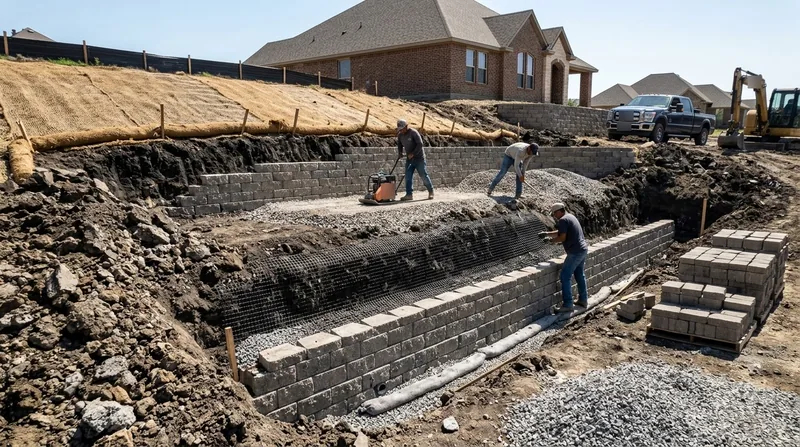




Slope Stabilization & Erosion Control in Plano
Plano sits on Blackland Prairie that looks flat from the road but drops hard behind the fence line. The wooded greenbelts of Spring Creek, Rowlett Creek, and Russell Creek cut deep draws through the city, and the steeper grades around Arbor Hills and Oak Point Park push runoff straight at backyard walls and pool decks. That deep black expansive clay shrinks and cracks through August drought, then swells and slides under spring thunderstorms. Slope Stabilization & Erosion Control in Plano is how you keep that ground where it belongs. We build terraced walls, set geogrid, and control water before a slope takes your fence, your pool, or the corner of your foundation with it. If the grade behind your house is already moving, start with leaning and collapsed wall repair before anything else.
Why Slope Stabilization Matters on Plano's Creek Lots and Graded Subdivisions
Most of the slope failures we see in Plano are not dramatic landslides. They are slow, ugly, and expensive: a creek-bank yard in the 75074 zip code losing six inches a season, a Hunters Glen lot where the builder graded a steep swale behind the fence, a Willow Bend pool deck settling because runoff has been undercutting the patio for years. The clay does the damage. It pulls away from the wall in a dry summer, then spring storms send water into the crack and the whole mass lets go.
- Rilling and gullying start where downspouts and lot drainage dump onto a bare slope with no vegetation holding it.
- Wall bulging and rotation show up when a low segmental block wall was built without geogrid or proper backfill drainage.
- Soil creep and fence lean signal that the slope itself is moving, not just the wall sitting on it.
- Pool deck and patio settlement happens when erosion hollows out the soil under a hard surface on a graded lot.
- Greenbelt and creek-bank washout accelerates after every flash runoff event along Spring Creek and Rowlett Creek.
Any one of those is cheaper to fix as stabilization than as a foundation or pool repair later.
Key info: A creek-lot homeowner near Oak Point Park called us after two straight springs of losing yard behind the fence. The fix was not a taller wall. It was a terraced segmental wall with geogrid, a surface drain at the top of the slope, and native grass replanting to stop the rilling.
Retaining walls above roughly 4 feet, or walls that carry a surcharge such as a driveway or structure, usually need a permit in North Texas jurisdictions, and engineered drawings may be required for tall or tiered walls. Always confirm the current thresholds with the City of Plano building department before work starts. The City of Plano publishes permit and development information that applies to grading and wall work on residential lots.
How We Stabilize a Plano Slope: Survey, Water Control, Structure, Vegetation
We do not sell a wall before we understand the water. On a Plano job we walk the slope, check where the runoff enters and exits, probe the clay, and look at what is downhill: a pool, a patio, a foundation, a neighbor's fence. Then we build the fix in the right order, because a wall without drainage just buys you a few more years before it leans.
- We map the drainage first and identify the source of the water, whether it is a downspout, a swale, a greenbelt outfall, or sheet flow off an uphill lot.
- We excavate and bench the slope in lifts so the new wall sits on stable ground instead of on top of loose fill.
- We set geogrid reinforcement in horizontal layers behind segmental block or concrete walls to tie the wall back into the hillside.
- We install drainage aggregate, filter fabric, and weep points so water leaves the wall instead of pushing it over.
- We build the structure in terraced lifts when the grade is too tall or too steep for a single wall.
- We finish the surface with compacted topsoil, erosion blanket, and native or adapted grass to hold the slope long term.
That sequence is why a stabilized slope in Plano holds through a drought summer and a storm spring, not just the first season.
Key info: On a graded lot in Murphy, the builder's rear swale dumped storm runoff onto a steep bank above a pool. We terraced the bank with two low segmental walls, added geogrid and a surface drain, and the pool deck stopped moving. The same approach works on the greenbelt edges around Russell Creek in Plano.
If the wall itself is already leaning, bulging, or separating from the soil, the stabilization plan has to include structural repair. See retaining wall repair for that side of the work, and retaining wall drainage for the water-control piece on its own.
Slope Stabilization Methods We Use Across Plano
Not every slope needs the same structure. A shallow backyard swale in Allen takes a different fix than a steep creek draw near Arbor Hills. We match the method to the grade, the soil, the water load, and what sits at the bottom of the slope.
| Approach | Description | Best for |
|---|---|---|
| Terraced segmental block walls | Two or more low walls stepped up the slope with geogrid tie-backs and drainage aggregate behind each lift. | Creek-lot backyards and graded subdivision slopes where a single tall wall would be over-permitted or unstable. |
| Geogrid-reinforced soil slopes | Layered grid and compacted fill that reinforce the soil mass itself, with a vegetated face instead of a hard wall. | Long, moderate slopes where a natural look is preferred and the grade does not need a vertical face. |
| Poured concrete and CMU walls | Rigid structural walls with footing and drainage, built to hold heavy surcharge loads. | Pool decks, driveways, and slopes carrying structural loads where block alone is not enough. |
| Boulder and natural stone toe protection | Rock placed at the toe of a slope or creek bank to absorb runoff energy and stop undercutting. | Spring Creek and Rowlett Creek banks where moving water is the main erosion driver. |
| Surface drainage and erosion blanket | Grading, swales, downspout extensions, and erosion control fabric with seed to move water off the slope. | Every stabilization job as the finishing layer, and as a standalone fix for mild rilling. |
Slope Stabilization & Erosion Control Cost in Plano: What to Expect
Every job starts with a free on-site estimate, and that is the only honest starting point. Slope work is priced by the linear foot of wall, the height and number of lifts, the amount of excavation and haul-off, and how much drainage and reinforcement the slope actually needs. A low single-lift wall behind a fence in Plano is a different number than a two-tier reinforced wall above a pool in Willow Bend.
Access moves the price as much as size does. A slope you can reach with a mini excavator from the driveway is cheaper than a creek bank where every block and bucket of gravel comes through a side gate by hand. Proximity to structures matters too: working next to a pool, patio, or foundation means more careful excavation and more time. Getting two or three estimates is smart, and not just on price. Ask each contractor what they found for drainage, whether they are specifying geogrid, and what permit threshold they expect to hit.
Key info: A homeowner in Frisco compared three bids on a failing railroad tie wall at the top of a slope. The lowest bid replaced the ties with new ties and no drainage. The correct fix was a segmental wall with geogrid and a drain. Ask what is behind the wall, not just what is in front of it.
For a fuller breakdown of how we price wall work, see our pricing overview.
Hiring a Retaining Wall Contractor Near Plano: What to Check Before You Sign
Slope stabilization is structural work, and the contractor you pick determines whether the fix lasts ten years or two. Plano homeowners should verify a few things before any crew touches the slope. None of this is complicated, and a good contractor will hand you the answers without being asked twice.
- Confirm fully insured status and ask for a certificate of insurance naming general liability and workers' compensation coverage.
- Get two or three written estimates that spell out wall height, reinforcement, drainage, and disposal, not just a lump sum.
- Check local references on jobs with similar slopes, especially creek-lot or pool-adjacent work in Plano and nearby Allen or McKinney.
- Ask who pulls the permit if the wall crosses the local height or surcharge threshold, and confirm the contractor knows the City of Plano requirements.
- Review HOA rules for wall height, material, and color before ordering block, since many Plano subdivisions restrict what is visible from the street.
Ask those five questions and the bids will sort themselves out fast.
Ready to look at your slope? Reach out through our contact page or call (469) 661-3741 for a free estimate. We serve Plano and the surrounding cities, including Frisco and Allen.
Slope Stabilization & Erosion Control in Plano: Pricing Guide
| Service | Price | Details |
|---|---|---|
| Slope stabilization site evaluation | Free estimate | On-site walk of the slope, drainage check, and written scope before any number is quoted. |
| Single-lift segmental block stabilization wall | Starting at $65 per linear foot | Includes excavation, geogrid, drainage aggregate, and block; height and access move the price. |
| Terraced or multi-lift reinforced wall | Starting at $95 per linear foot | Two or more lifts with geogrid and drainage; slope height and proximity to pool or patio drive cost. |
| Erosion control and surface drainage only | Starting at $1,800 | Grading, swales, downspout extensions, erosion blanket, and seed for mild rilling and sheet flow. |
| Complex or large-scale slope job | On estimate | Creek-bank, engineered, or surcharge-loaded slopes need an on-site look before pricing. |
| Estimate and travel | Free, included | In Plano and surrounding areas, no mileage fee; response within 24 hours at (469) 661-3741. |
Indicative pricing, the exact cost depends on square footage, finish, and site access. Free personalized estimate within 24h at (469) 661-3741.


