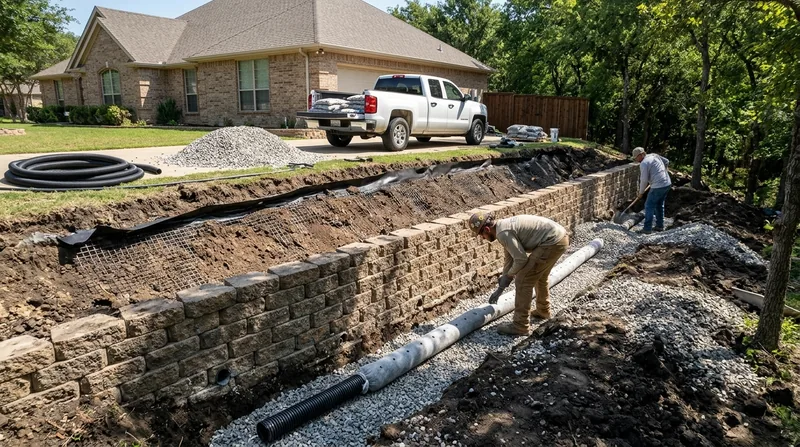




Retaining Wall Drainage in Plano: Keeping Blackland Clay From Pushing Your Wall Over
Plano sits on flat to gently rolling Blackland Prairie, cut by the wooded greenbelts of Spring Creek, Rowlett Creek and Russell Creek, with steeper draws around Arbor Hills and Oak Point Park. That deep black expansive clay is the whole story here: it shrinks and cracks through August drought, then swells hard under spring thunderstorms and flash runoff. When water can't escape, it loads the back of the wall and hydrostatic pressure does the damage. Retaining Wall Drainage in Plano is the work that relieves that pressure before a wall leans, bows or drops a course of block. We build French drains, weep holes, gravel backfill and waterproofing for the low to mid-height segmental block, chopped limestone, poured concrete and aging timber walls across Hunters Glen, Gleneagles, Willow Bend and the older brick ranches near Downtown Plano. If your wall is already moving, start with our leaning and collapsed wall repair page, because drainage is part of that fix too.
Why Drainage Decides Whether a Plano Retaining Wall Survives the Clay
Most failed walls we open up in Plano were never short on block or concrete. They were short on a way for water to get out. Saturated clay backfill turns into a heavy, slow-moving mass that pushes outward every time it swells, and a wall designed for dry soil takes that load straight on the face. The failure mode that dominates here is hydrostatic pressure against a wall with no relief, not frost and not coastal moisture.
- Water trapped behind the wall saturates the clay and multiplies the lateral load.
- Missing or clogged weep holes let the water table behind the wall climb.
- Fabric-wrapped gravel that was never installed lets fines plug the drain over time.
- Downspouts and pool overflow dumped at the top of the wall feed the problem all year.
- Tree and shrub roots in the greenbelt lots crush shallow drain lines and block flow.
Fix the drainage and the wall stops moving; skip it and even a new wall will lean within a few wet seasons.
Key info: A creek-lot wall in the Russell Creek greenbelt near Willow Bend had weep holes packed with clay and no gravel behind the block. We cleared the outlets, cut in a perforated French drain and re-backed the wall with washed gravel. The wall stopped seeping within one storm cycle. For the code side on wall height and permits, check the City of Plano building department at plano.gov.
How We Install Retaining Wall Drainage on Plano Lots
We work from the soil out, not the wall in. Every drainage job starts with reading the slope, the runoff path and the wall itself, because a wall at the bottom of a long Blackland clay grade needs a different system than a short bed wall beside a pool deck. We open the back of the wall, correct what's failed and rebuild the drainage so water leaves the wall zone instead of sitting in it.
- We inspect the wall face, footing and backfill to find where water is entering and where it is trapped.
- We excavate behind the wall and remove saturated clay, roots and failed fabric or gravel.
- We set a perforated French drain at the footing with the correct fall to a daylight outlet.
- We install washed gravel backfill wrapped in filter fabric so clay fines cannot plug the drain.
- We open or rebuild weep holes at regular spacing along the base of the wall.
- We waterproof the back face where the wall holds soil against a structure or driveway.
- We redirect downspouts and surface flow so runoff stops dumping at the top of the wall.
On newer stone-and-brick homes near Legacy and in Frisco and Allen, we often tie the wall drain into the lot's existing storm path so the outlet has somewhere real to go.
Key info: A 1990s two-story in Hunters Glen had a segmental block wall along the back patio that seeped after every spring storm. We cut in a French drain at the footing, re-backed it with washed gravel and fabric, and routed the outlet to the side yard. The patio stayed dry through the next rainy season. See our block and segmental retaining walls page for how we build the wall itself.
Drainage Approaches We Use on Plano Walls
The right approach depends on wall height, soil, slope and where the water can legally go. We match the system to the site rather than selling one method to every yard.
| Approach | Description | Best for |
|---|---|---|
| Footing French drain | Perforated pipe at the base with washed gravel and filter fabric, daylighted to a safe outlet. | Most segmental block and concrete walls on clay. |
| Weep holes and gravel backfill | Open outlets through the wall face with clean gravel behind to release water. | Low walls and bed walls where a full drain is not needed. |
| Waterproofing membrane | Membrane on the back face where the wall holds soil against a structure. | Pool decks, driveways and walls tied to the house. |
| Surface and downspout redirection | Regrade the top of the wall and move roof runoff away from the wall zone. | Walls at the bottom of a long grade or below a roofline. |
| Drain repair and re-backfill | Clear crushed lines, replace failed fabric and rebuild gravel behind an existing wall. | Older walls that seep but have not yet moved. |
Every system gets an outlet we can verify, because a drain that dead-ends is worse than no drain at all.
Retaining Wall Drainage Cost in Plano: What to Expect
Drainage work starts from $2,500 for a standard residential wall, and that figure covers opening the back of the wall, a footing French drain, washed gravel and fabric, weep holes and a daylight outlet. Price climbs with wall length and height, how much saturated clay has to come out, and whether the outlet has to be trenched a long way to reach a storm path. Access matters too: a wall tight against a pool deck or fence line takes more hand work than an open backyard.
Walls near Arbor Hills and Oak Point Park often sit on steeper draws where the drain has to handle more runoff, and those jobs land higher. Getting two or three estimates is smart because drainage scope varies so much from one wall to the next. Our full pricing overview breaks down the ranges in more detail.
What to Look for When Hiring a Retaining Wall Drainage Contractor Near Me in Plano
Drainage is invisible once the gravel goes back in, so hire on process, not on a low number. Ask how the contractor will handle the outlet, what happens to the saturated clay, and whether they will pull a permit if the wall is tall or holds a surcharge. A wall above roughly 4 feet from the footing, or one supporting a driveway or structure, may need a permit and engineered drawings, and thresholds vary by jurisdiction, so confirm with the City of Plano building department before work starts.
- Confirm the contractor is fully insured and ask for the certificate.
- Get two or three written estimates with the drain layout spelled out.
- Ask for references from Plano, Frisco or McKinney walls at least two years old.
- Check HOA rules for wall height, materials and drainage outlets before you sign.
If a contractor cannot explain where the water goes, keep looking. Reach us through our contact and free estimate page when you are ready.
Retaining Wall Drainage in Plano: Pricing Guide
| Service | Price | Details |
|---|---|---|
| Basic wall drainage | Starting at $2,500 | Footing French drain, washed gravel, filter fabric and weep holes for a standard residential wall. |
| Full drainage and waterproofing | Starting at $4,200 | Adds back-face membrane and downspout redirection where the wall holds soil against a structure. |
| Drain repair and re-backfill | Starting at $1,800 | Clears crushed lines, replaces failed fabric and rebuilds gravel behind an existing wall. |
| Long-run or steep-slope drainage | On estimate | Needs an on-site look because trench length, outlet distance and runoff volume drive the number. |
| Travel | Included | In Plano and surrounding areas, no separate call-out or mileage fee. |
| Estimate | Free | Response within 24h at (469) 661-3741, no obligation to book. |
Indicative pricing, the exact cost depends on square footage, finish, and site access. Free personalized estimate within 24h at (469) 661-3741.


