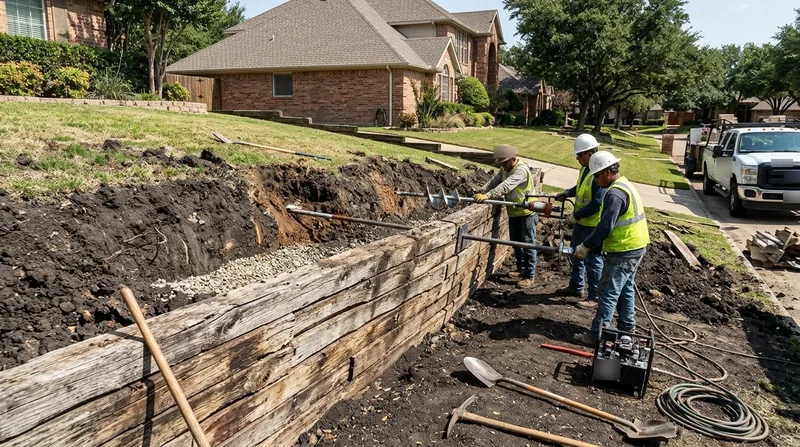




Leaning & Collapsed Wall Repair in Plano
Plano sits on Blackland Prairie clay that shrinks hard in August drought and swells fast under spring storms, and that cycle is what pushes most retaining walls out of plumb. Whether you have a segmental block wall along a Spring Creek backyard, a chopped limestone bed near Downtown Plano, or a railroad tie wall in Hunters Glen that finally gave out, Leaning & Collapsed Wall Repair in Plano is the call that stops the damage from spreading to your pool deck, driveway, or foundation. We stabilize, we correct drainage, and we rebuild only what cannot be saved. If you are still deciding between fixing and starting over, compare our retaining wall repair service with a full replacement before you spend a dollar.
Why Leaning Walls Keep Failing on Plano's Expansive Clay
Most walls we inspect in Plano did not fail because the block was weak. They failed because water got behind the wall and the clay under the footing moved. In the older brick ranches east of Downtown Plano and around Hunters Glen, we routinely find 1980s timber and railroad tie walls with no gravel backfill and no drain pipe, so every storm loads the wall from behind until it bulges. Newer stone-and-brick homes near Legacy and Willow Bend fail differently: tall segmental walls built tight to the property line with poor compaction, where the top courses creep forward a half inch a year until someone notices.
- Hydrostatic pressure builds when clay soil and storm runoff cannot drain through the wall.
- Expansive clay shrinks in drought and swells in spring, lifting and rotating the footing.
- Rotted timber and railroad ties lose their structural section and lean under load.
- Missing or crushed drain pipe and clogged gravel behind the wall trap water all year.
- Tree roots and creek-lot erosion undercut the base along Spring Creek and Rowlett Creek.
Any one of these can take a wall from a slight lean to a collapse in a single storm season, so the earlier we look, the cheaper the fix.
Key info: A wall in the 75074 area that leans more than about 2 inches over 4 feet of height is already past cosmetic. On Plano's clay, that much movement usually means the footing has rotated, and patching the face will not hold it.
For the official rules on walls, footings, and when engineered drawings are required, check the City of Plano building department before you schedule work, since thresholds vary by jurisdiction.
How We Repair a Leaning or Collapsed Wall in Plano
We start by finding out why the wall moved, not just where it cracked. A wall that leaned because of water needs drainage correction before anything else, or the repair fails again next spring. A wall that collapsed because the base washed out along a creek lot needs the footing rebuilt and the slope stabilized. Every job follows the same sequence, adjusted to what we find on site.
- We excavate behind the wall and expose the footing to see how far the movement goes.
- We relieve the pressure by correcting drainage, installing gravel, filter fabric, and drain pipe.
- We stabilize leaning sections with tieback anchors or helical piers where the wall can be saved.
- We rebuild collapsed sections course by course, matching block, stone, or concrete where possible.
- We compact the backfill in lifts and recheck plumb before we close the excavation.
When the drainage is the root cause, we bring in our retaining wall drainage service so the repair holds through the next wet cycle.
Key info: On a creek-lot wall in the 75013 area near Allen, we found the drain pipe crushed flat under the backfill and the clay saturated to the footing. We re-excavated, reset the base course, added clean gravel and a new perforated pipe, and anchored the top two courses. The wall has held plumb through two spring seasons.
Repair Approaches We Use on Plano Walls
Not every leaning wall needs the same treatment, and not every collapsed wall needs a full rebuild. We choose the approach based on wall height, material, access, and how much of the footing has moved.
| Approach | Description | Best for |
|---|---|---|
| Tieback anchoring | We drive anchors through the wall face into stable soil behind it and tension them to pull the wall back toward plumb. | Leaning block and concrete walls with an intact base |
| Drainage correction | We replace failed drain pipe, add washed gravel and filter fabric, and restore grade so water leaves the wall. | Bulging walls and any wall with wet soil behind it |
| Partial rebuild | We remove and reset the failed courses, rebuild the footing where needed, and match the original material. | Collapsed sections on otherwise sound walls |
| Full rebuild with new base | We tear out the failed wall, excavate to stable soil, and rebuild with proper footing and drainage. | Rotted timber and railroad tie walls past repair |
| Helical pier support | We install screw piers under the footing to reach load-bearing soil and stop further settlement. | Walls sinking on deep clay or near a structure |
We confirm the right approach after we expose the footing, because the visible lean rarely tells the whole story.
Leaning & Collapsed Wall Repair Cost in Plano: What to Expect
Most leaning wall repairs in Plano start around $2,500, and that figure covers a modest wall with drainage correction and anchor stabilization. A partial rebuild of a collapsed section typically lands higher, and a full rebuild of a long creek-lot wall with poor access runs into five figures. The number moves with wall height and length, how much of the footing has moved, whether the wall is block, poured concrete, boulder, or timber, and how close the work sits to a pool, driveway, or property line. A wall backing onto a greenbelt with no equipment access costs more to fix than the same wall beside a driveway.
We recommend getting two or three written estimates on any repair over a few thousand dollars, and asking each contractor whether the price includes drainage correction or just the visible fix. A quote that resets the face without fixing the water behind it is not a repair. Our pricing overview shows how the scopes break down before you call.
Hiring a Retaining Wall Repair Contractor Near Me in Plano
Plano homeowners have plenty of choices, and the difference between a repair that lasts and one that fails in two years comes down to a few checks you can do before you sign. Ask for the license and insurance certificate, then verify the coverage is current. Ask how the contractor plans to handle water behind the wall, because on this clay that is the whole job. Ask for references on walls of similar height and material, and call them. If the wall is over roughly 4 feet or supports a driveway, confirm who is pulling the permit with the City of Plano, since taller and surcharge walls often need engineered drawings. If your neighborhood has an HOA, check the architectural rules before work starts. You can request a free estimate and we will walk the wall with you.
Leaning & Collapsed Wall Repair in Plano: Pricing Guide
| Service | Price | Details |
|---|---|---|
| Drainage correction and stabilization | Starting at $2,500 | Covers excavation, new gravel and drain pipe, and anchor stabilization on a low wall with clear access |
| Partial rebuild of a collapsed section | Starting at $4,200 | Removes and resets failed courses, rebuilds footing where needed, and matches existing block or stone |
| Full rebuild of a failed wall | On estimate | Needed when the footing has rotated or the wall is rotted timber, priced after we expose the base |
| Travel | Included | in Plano and surrounding areas, no separate call-out or mileage fee |
| Estimate | Free | Response within 24h at (469) 661-3741, no obligation to book |
Indicative pricing, the exact cost depends on square footage, finish, and site access. Free personalized estimate within 24h at (469) 661-3741.


