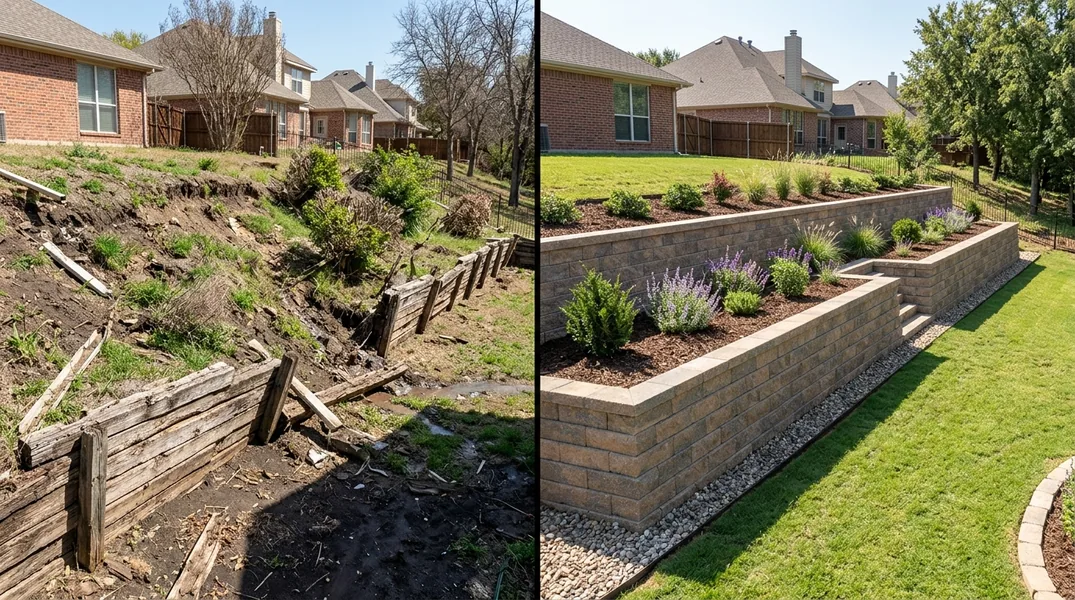
Why Retaining Walls Lean in Plano's Expansive Clay Soil
If you have noticed your retaining wall tilting outward, you are not alone. Plano sits on some of the most active clay soil in North Texas, and that soil expands when it absorbs water and shrinks dramatically during dry spells. This constant cycle of swelling and contracting pushes against the back of a retaining wall with tremendous force. Over time, even a well-built wall can begin to lean, especially if the original drainage was not designed for our specific soil conditions.
Hydrostatic pressure is the other major culprit. When water cannot escape through proper weep holes and gravel backfill, it saturates the soil behind the wall and creates pressure that the structure was never meant to handle. Many older walls in neighborhoods around Plano were built without modern drainage techniques, which is why we see so many leaning walls from the 1990s and early 2000s. Understanding the cause is the first step toward deciding whether a repair will hold or whether replacement is the smarter long-term investment.
Signs Your Leaning Retaining Wall Needs Repair (Not Replacement)
Not every lean is a crisis. A wall that has shifted less than an inch or two over many years, with no visible cracking and no bulging, can often be stabilized and corrected. Leaning retaining wall repair is usually the right path when the movement is minor, the wall is still structurally sound, and the underlying drainage problem can be fixed. In these cases, we can often reset the top courses, improve the drainage behind the wall, and reinforce the footing so the wall stops moving.
Retaining wall crack repair is also a viable option when the cracks are hairline or surface-level and have not compromised the structural integrity of the wall. Cracks that run vertically through a few blocks, or small settling cracks in a concrete wall, can typically be sealed and monitored. However, if you see diagonal cracks that widen at the top, or if the wall has begun to bulge outward in the middle, those are warning signs that the structure is failing and repair may only be a temporary bandage. A professional inspection can tell you which category your wall falls into, and you can request a free estimate to get a clear answer.
When Retaining Wall Replacement Is the Better Choice
Sometimes the honest answer is that the wall has moved beyond what repair can safely fix. If the wall is leaning more than a few inches, has significant bulging, or shows large cracks that go through multiple courses, Retaining Wall Replacement is usually the more cost-effective decision. Patching a structurally compromised wall often means you will be back in the same position in a few years, having spent money on repairs that did not address the root cause.
Replacement also makes sense when the original wall was underbuilt for its load. Many older walls were constructed with too little base, no geogrid reinforcement, and inadequate drainage. A new wall designed for Plano's clay soil, with proper footing depth, gravel backfill, and weep holes, will perform far better. If you are considering a rebuild, Concrete Retaining Walls are an excellent option for our climate because they resist moisture damage and hold up well against soil movement. We also handle full Retaining Wall Installation for homeowners in Frisco and Allen who are starting fresh.
Leaning Retaining Wall Repair Near Me: How to Choose the Right Approach
When you search for leaning retaining wall repair near me, you will find plenty of contractors who can patch a wall. The difference is in the diagnosis. A proper evaluation should include checking the wall's alignment, inspecting the drainage behind it, and determining whether the footing is still stable. If a contractor simply offers to push the wall back without addressing why it moved, the lean will return. Ask questions about drainage, base preparation, and reinforcement before you commit to any repair plan.
At Plano Retaining Wall, we start every project with an honest assessment of whether repair or replacement makes more sense for your budget and your property. Sometimes a targeted Retaining Wall Repair is all you need, and we will tell you so. Other times, replacement is the wiser investment, and we will explain exactly why. You can review our pricing to get a sense of what different approaches cost, or call us at (469) 661-3741 to talk through your situation with someone who works in this soil every day.
What to Expect During Repair or Replacement in Plano
If repair is the right call, the process usually starts with relieving the pressure behind the wall. That means removing some of the soil, correcting the drainage, and then resetting or reinforcing the wall so it can handle future soil movement. Depending on the wall type, this can often be done in a day or two. For concrete walls, crack repair typically involves cleaning and sealing the cracks, then monitoring the wall to make sure the movement has stopped. In many cases, homeowners in McKinney and Plano are surprised at how much can be corrected without a full rebuild.
If replacement is necessary, expect a more involved project. A new wall needs a properly excavated base, compacted gravel, and often geogrid reinforcement to tie the wall into the soil behind it. Drainage is non-negotiable in our clay soil, so a good builder will include weep holes and a gravel drainage zone. The timeline depends on the length and height of the wall, but most residential projects are completed within a week or two. The goal is a wall that stays put through wet springs and dry summers, so you are not dealing with the same lean five years from now.
Get a Straight Answer Before You Spend a Dollar
The worst thing you can do with a leaning wall is ignore it and hope it stabilizes. Small leans tend to get worse, and a wall that could have been repaired affordably last year may need full replacement this year. The second worst thing is paying for a repair that does not address the cause. Whether you need a minor fix or a complete rebuild, the decision should be based on an honest inspection, not a sales pitch. We are happy to give you a clear recommendation and a written estimate so you can plan accordingly.
If you are ready to find out whether your wall needs repair or replacement, reach out to Plano Retaining Wall for a free estimate. You can also call us directly at (469) 661-3741. We serve homeowners throughout Plano and the surrounding communities, and we will tell you plainly what your wall needs and what it will take to get it back to safe and stable.
Looking for a professional retaining wall contractor in Plano? Plano Retaining Wall responds fast for all your retaining wall needs.
Get a Free QuoteOur services: Retaining Wall Installation · Retaining Wall Repair · Retaining Wall Replacement