Why Expansive Clay Makes Retaining Wall Material Choice So Important
If you live in Plano, you already know the soil here has a personality. The black and gray clay that dominates North Texas swells dramatically when it absorbs water and shrinks just as hard when it dries out. That constant cycle of expansion and contraction puts enormous lateral pressure on anything built into or against it, and a retaining wall is right in the line of fire. A wall that would perform beautifully in sandy or rocky soil can crack, lean, or fail within a few seasons here if the material and drainage are not matched to the ground.
The good news is that local contractors have decades of experience building against this clay, and certain materials consistently outperform others. The right choice depends on the height of your wall, how much water it will need to shed, your budget, and the look you want for your yard. Below we break down the four materials we trust most for North Texas conditions, along with what each one does well and where it can fall short.
Concrete Retaining Walls: The Heavyweight Champion of Clay Country
When homeowners ask what holds up best against expansive clay, Concrete Retaining Walls are usually the first answer. Poured concrete is massive, rigid, and resistant to the flexing that clay movement causes in lighter materials. A properly engineered concrete wall, with a reinforced footing set below the active clay zone and adequate steel throughout, can handle the pressure that comes from saturated soil pushing outward after a heavy spring rain. It also requires very little maintenance once it cures, which is a real advantage in a climate that swings from drought to downpour.
The tradeoff is cost and appearance. Concrete is typically the most expensive option upfront, and unless you choose a stamped or textured finish, it can look utilitarian. For tall walls or walls holding back a significant slope, though, the structural reliability is hard to beat. If you are weighing options for a serious grade change, it is worth getting a free estimate so you can compare concrete against the alternatives on both performance and pricing.
Block Retaining Walls and Segmental Systems: Flexibility That Works With the Soil
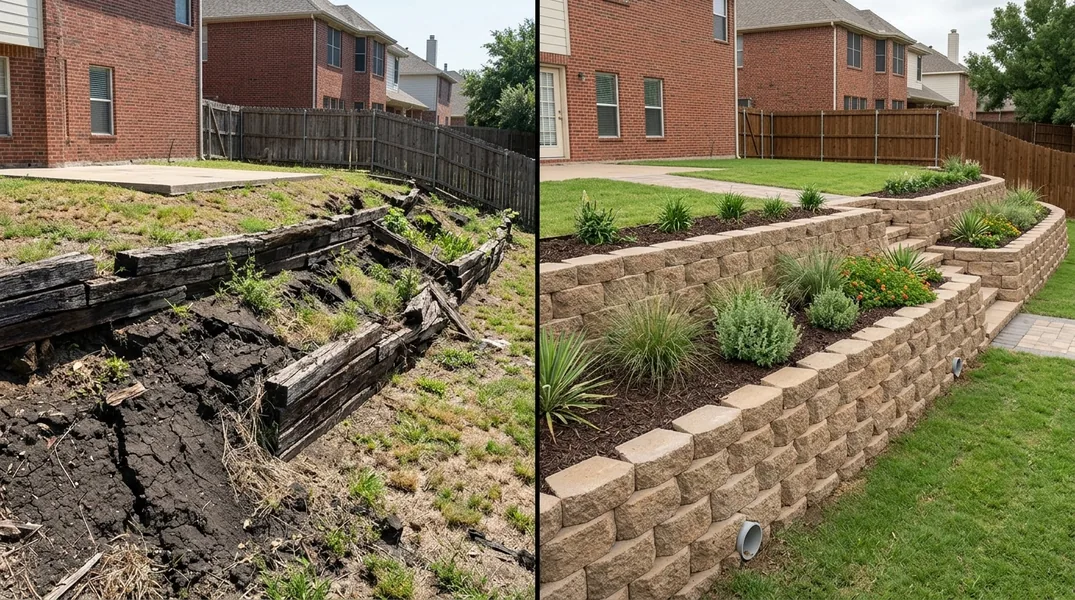
A Retaining Wall Installation using block is one of the most popular choices in North Texas, and for good reason. Segmental retaining wall systems are engineered as a series of interlocking units that flex slightly rather than fighting the soil rigidly. That flexibility is a genuine asset when clay moves, because the wall can accommodate small shifts without cracking the way a monolithic pour might. Modern segmental blocks also come in a wide range of colors and textures, so you can get a natural stone look without the premium price of real stone.
The key to a block retaining wall that lasts is what happens behind it. These systems depend on proper geogrid reinforcement, a compacted gravel base, and a reliable drainage path so water never pools against the back of the wall. When those details are handled correctly, a segmental retaining wall can deliver decades of service. When they are skipped, even high-quality block will bulge and fail. This is exactly where a local installer who understands expansive clay earns their keep.
Limestone Retaining Walls: A Natural Fit for Texas Landscapes
Limestone is practically a native material in this part of the state, and a Retaining Wall Repair or new build using limestone blends beautifully into Texas landscaping. Chopped or sawn limestone blocks are dense and heavy, giving them good resistance to the pressures that expansive clay generates. They also age gracefully, developing a weathered character that many homeowners prefer to the uniform look of manufactured block. For garden walls and low retaining walls, limestone is often the most attractive option available.
Limestone does have limitations worth understanding. It is porous, so it absorbs water, and in a freeze-thaw event that moisture can cause surface spalling over time. It is also best suited to walls under a certain height unless it is engineered and reinforced properly. For taller or more heavily loaded walls, many homeowners in Frisco and Allen combine a structural core with a limestone veneer to get the look without sacrificing strength. A good contractor will tell you honestly when limestone is the right call and when it is not.
Retaining Wall Installation Near Me: Matching the Material to Your Project
There is no single best material for every wall, and any contractor who claims otherwise is oversimplifying. A two-foot garden wall holding back a planting bed has very different demands than a six-foot wall terracing a steep backyard. Height, soil moisture, drainage patterns, surcharge loads from driveways or structures above, and the finished look you want all factor into the decision. The most reliable approach is to have a professional evaluate your specific site, because the clay on one lot in McKinney can behave differently from the clay a mile away.
If an existing wall is already showing signs of trouble, leaning, cracking, or bulging, a Retaining Wall Replacement may be more economical than repeated patches, especially if the original build ignored drainage. Either way, the conversation should start with your soil and your slope, not with a catalog. Call Plano Retaining Wall at (469) 661-3741 to talk through your project, or request a free estimate online and get a material recommendation grounded in how North Texas clay actually behaves.
Looking for a professional retaining wall contractor in Plano? Plano Retaining Wall responds fast for all your retaining wall needs.
Get a Free QuoteOur services: Retaining Wall Installation · Retaining Wall Repair · Retaining Wall Replacement